
What If You Have Never Done Anything Wrong?

A few weeks ago, I heard Peter Crone say something in a video that stopped me in my tracks:
“You have never done anything wrong.”
I felt something inside me release.
Not because I believe I have moved through more than seven decades of life without making mistakes. Of course I have.
I have made choices I would make differently today. I have hurt people. I have missed opportunities. I have spent money I wish I had saved and worried about decisions long after there was anything I could do to change them.
But that wasn't what I heard in those words. What I heard was:
Maybe my life has not been the long record of wrongness I have unconsciously believed it to be.
And that was a very different perspective.
The Story Beneath the Story
I have spent much of my life trying very hard to get things right. I worked hard, achieved, tried to anticipate problems before they happened, and attempted to control outcomes.
From the outside, some of that probably looked like ambition, competence and determination.
And some of it was.
But looking back now, I can also see another force underneath it.
If I could do enough, achieve enough, manage enough and get enough things right, perhaps I could finally prove that I was enough.
I don't know exactly when that belief began.
One of my earliest memories of it comes from losing my father. Somewhere inside the mind of a child, his absence became connected to me:
Maybe I wasn't good enough for him to stay.
Years later, at seventeen, I became pregnant.
I was sent away so the neighbors wouldn't know, and I placed my baby up for adoption.
Whatever the adults around me intended, the message I absorbed was unmistakable:
Something had gone terribly wrong.
And I was the one who had done it.
Shame has a way of attaching itself not simply to what we did, but to who we believe we are.
There is an enormous difference between:
I made a choice that had consequences.
and
There is something wrong with me.
I realize now how much of my life may have been shaped by the second story.
When a Belief Becomes a Lens
This month I've been writing about perspective and the lens through which we interpret our lives.
Usually we think of perspective as something relatively immediate.
Someone doesn't return our call, and we decide they're upset with us.
An opportunity disappears, and we decide we've failed.
A plan falls apart, and we decide something has gone wrong.
Then perhaps we pause and ask:
What else could be true?
But some perspectives live much deeper than that.
They become core beliefs.
And because we've carried them for so long, we stop recognizing them as beliefs at all.
They simply feel like truth.
I'm not enough.
I have to prove myself.
I can't trust things to work out.
If I don't stay in control, something bad will happen.
I have to get this right.
Once a belief settles deeply enough into us, it can quietly organize an astonishing amount of our lives.
We interpret through it.
We make decisions through it.
We build relationships through it.
We strive through it.
And because we don't realize we're looking through a lens, we assume we're simply seeing reality.
The Gift and the Burden
I can see now that my particular lens has been both a gift and a burden.
That need to prove myself helped propel me forward.
I worked hard. I learned. I accomplished things. I took risks. I developed skills. I built a career and created a life I am proud of in many ways.
So I don't want to make the part of me that overachieved into another thing I did “wrong.”
She was trying to help me. She believed achievement would keep me safe, control would keep bad things from happening, and hard work would prove my worth.
And for a very long time, those strategies worked well enough that I had little reason to question them.
But every survival strategy eventually sends us a bill.
The cost of believing you have to get life right is that life becomes frighteningly easy to get wrong.
You second-guess yourself.
You try to control things that were never yours to control.
You work harder than necessary.
You confuse productivity with worth.
You hesitate because the possibility of making the wrong choice feels heavier than the possibility of discovering something new.
And even achievement can become strangely unsatisfying because it never permanently answers the question underneath it:
Am I enough yet?
What If Nothing Has Gone Wrong?
This is where the soul perspective changes something for me.
I have written before about my belief that things happen for a reason.
That doesn't mean I believe everything that happens is pleasant, fair or understandable while we're living through it.
Sometimes life hurts. Our choices can create painful consequences, and other people's choices can wound us deeply.
But from a wider perspective, I believe our lives are more than a collection of successes and failures.
They are experiences through which we learn and relationships through which we discover ourselves.
Choices that take us down one path and sometimes redirect us toward another.
Moments that reveal where we still need to heal.
Lessons that make sense only when we are far enough down the road to look back.
From that perspective, perhaps the better question isn't:
What did I do wrong?
Perhaps it is:
What was I learning?
What was I believing?
What was I trying to protect?
What did this experience eventually teach me?
Who did I become because I lived through it?
That is a very different lens.
The Same Life, Seen Differently
Nothing about my past changed when I heard the words, “You have never done anything wrong.”
My father still died.
I still became pregnant at seventeen.
I still gave my baby up for adoption.
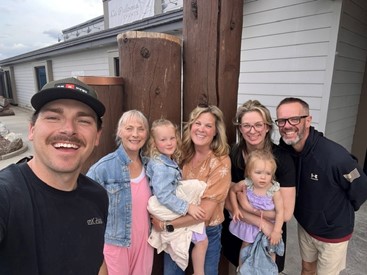
But there is another part of that story I could never have seen at seventeen. My daughter and I reconnected when she was 30, and she and her family have enriched my life in ways I could never have imagined then.
I still made financial choices I would make differently knowing what I know today.
The facts didn't change.
The meaning did.
For perhaps the first time, I considered the possibility that these events were not evidence in a lifelong case against me.
They were part of a life.
A complicated, imperfect, sometimes painful, sometimes magnificent human life.
And I was never required to earn my way back into worthiness.
That possibility felt like putting down something I had carried for a very long time.
What Might Change If You Changed the Lens?
I've wondered since then what my life might have looked like if I had believed this sooner.
Would I have accomplished less because I wasn't driven so hard?
Perhaps.
But I also wonder whether I might have accomplished more.
What might I have attempted if I had trusted myself more?
What might I have created if my energy had come from curiosity rather than fear?
What decisions might I have made if I weren't so worried about choosing incorrectly?
What would it have felt like to work from a fundamental belief that life was supporting my growth rather than waiting to grade my performance?
I may never know.
But I can see now that every version of me was doing the best she could with what she understood at the time.
And this perspective arrived when I was ready to receive it.
Perhaps that is part of the lesson too.
Move the Camera Back
Sometimes changing perspective means finding another interpretation of something happening today.
And sometimes it means moving the camera much farther back.
Far enough to see the belief behind decades of choices.
Far enough to recognize that the story you thought was simply your life was actually one interpretation of your life.
Far enough to ask: What if I have been looking at myself through the wrong lens?
I still catch my mind heading down familiar paths.
You should have done that differently.
You should have known.
You got that wrong.
You're not enough.
But now I have another perspective available to me.
I can pause.
I can move the camera back.
And I can remember:
I have been learning.
I have been becoming.
I have been doing the best I knew how to do with the awareness I had at the time.
And perhaps my life was never asking me to get everything right.
Perhaps it was asking me to experience it.
To learn from it.
To grow through it.
And, eventually, to see myself with different eyes.
About the author
Cindi Bergen
As a child, Cindi believed in the magic of fairies — and as an adult, she never lost her ability to sense what’s unseen. Instead, she learned to translate it. What looks like magic to most isn’t an accident or a mystery… it’s the expression of universal principles most people never learned to read.
Through her own life experiences — from doubt to surrender, from stress to peace — Cindi became a bridge-builder between what the heart feels and what science proves. She intuitively translates deep spiritual insight into grounded understanding, and rigorous psychological research into actionable, heart-centered tools.
Her work is rooted in:
Cindi created the signature FLIP IT technique to help people shift out of negativity and into a positive perspective — not just temporarily, but in a way that becomes sustainable, embodied, and transformative.
She holds a master’s degree in Instructional and Performance Technology and has studied Appreciative Inquiry, a transformational change methodology grounded in psychology, sociology, and organizational behavior. Before dedicating her life to First Create Happiness, she spent years in training and development supporting Fortune 500 companies — helping people understand not just what to think, but how to think in ways that open possibility.
What she teaches isn’t about perfection. It’s about remembering who you truly are, reconnecting with your innate joy, and creating a life that reflects not just your desires — but your deepest self.
Cindi doesn’t ask you to believe blindly.
She invites you to experience what’s real.