
We Don’t Wait for the Light — We Create It
Winter Solstice, Celebration, and the Psychology of Meaning
For several years, my dear friend Lynda and I hosted a Winter Solstice celebration at her home. Those gatherings taught me something about celebration that still shapes how I move through the world.
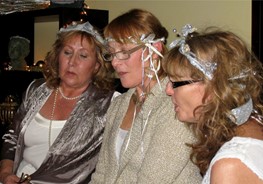
We planned for weeks — sometimes months. Not because we wanted perfection, but because preparation itself felt sacred. Decorating her beautiful house on the hill overlooking the city became part of the ritual. Halos were made from ribbon and garlands. Bindis were chosen with care. Invitations were sent formally, asking guests to wear white, silver, or gold and to bring food to share.
Over time, something unexpected happened.
People began requesting invitations.
They felt there was something different about these gatherings — something intentional, grounding, and alive. And they were right.
Marking the Darkest Night
Long before modern holidays, humans gathered in midwinter to mark the longest night of the year. Across cultures and centuries, the Winter Solstice represented a turning point — not because the light had returned yet, but because it would.
Ancient solstice rituals were acts of courage and meaning-making. Fire was lit not only for warmth, but as reassurance. Candles symbolized hope. Gathering itself was a declaration: we are still here.
Psychologically, this makes perfect sense.
Humans are meaning-making beings. When uncertainty rises — when days are short, cold, and dark — our nervous systems seek structure, connection, and reassurance. Ritual gives us a way to pause, reflect, and transform fear into purpose.
We don’t celebrate because life is easy.
We celebrate because it isn’t.
Creating Sacred Time
At a certain point during our solstice gatherings, conversation softened. Guests were invited to move quietly into a line that led through the kitchen and into the living room.
Inside, chairs were arranged in a circle. At the center sat an altar with a Mother Candle resting in sand, baskets for pine boughs, and space for intention.
Four designated blessers offered each person a candle, a pine bough, holy water Lynda had collected during her travels, and a touch of fairy dust. One by one, people stepped into the center of the circle.
They spoke aloud what they were ready to let go of.
They placed their pine bough in the basket.
Then they lit their candle from the Mother Candle and named what they wished to bring into the new year.
Psychology tells us that when emotions are expressed aloud — witnessed and acknowledged — they lose their grip. Letting go becomes real. Intention becomes embodied.
Ritual is the container.
Celebration is the feeling that fills it.
What We Release Becomes Compost
At the end of the sharing, the basket of pine boughs was rearranged with flowers and pinecones. We explained that what we let go of was not meaningless — it was compost.
The hard moments.
The disappointments.
The grief.
All of it could nourish what was next.
This idea echoes both ancient wisdom and modern psychology. Growth doesn’t happen by bypassing difficulty — it happens by integrating it. When we acknowledge pain and give it purpose, it becomes part of our becoming.
Celebration, in this sense, isn’t denial.
It’s transformation.
Joy as a Shared Experience
After the ritual, we invited sharing. Laughter often bubbled up — even during moments of release. Then we sang. We closed the directions. And finally, we feasted, gathered on the patio, shared food, stories, scotch, cigars, and connection late into the night.
These weren’t quiet or solemn events. They were joyful, human, alive.
Research in positive psychology shows that shared celebration strengthens belonging, trust, and emotional resilience. Joy multiplies when it’s witnessed. Meaning deepens when it’s shared.
This is why humans have always celebrated together.
The Light We Make
Those Winter Solstice celebrations remain some of the most meaningful experiences of my life — not because they were elaborate, but because they were intentional.
They taught me something I carry to this day:
- People didn’t wait for the sun — they lit fires.
- They didn’t wait for ease — they created meaning.
- They didn’t wait for joy — they celebrated intentionally.
Winter Solstice reminds us of a profound truth that still applies today:
We don’t wait for the light to return.
We create it — together.
And in doing so, we create happiness first.
A Reflection for You
As this season unfolds, you might ask yourself:
What would it look like to mark this time with intention instead of urgency?
Where might a small ritual help you create a little more light — right now?
About the author
Cindi Bergen
As a child, Cindi believed in the magic of fairies — and as an adult, she never lost her ability to sense what’s unseen. Instead, she learned to translate it. What looks like magic to most isn’t an accident or a mystery… it’s the expression of universal principles most people never learned to read.
Through her own life experiences — from doubt to surrender, from stress to peace — Cindi became a bridge-builder between what the heart feels and what science proves. She intuitively translates deep spiritual insight into grounded understanding, and rigorous psychological research into actionable, heart-centered tools.
Her work is rooted in:
Cindi created the signature FLIP IT technique to help people shift out of negativity and into a positive perspective — not just temporarily, but in a way that becomes sustainable, embodied, and transformative.
She holds a master’s degree in Instructional and Performance Technology and has studied Appreciative Inquiry, a transformational change methodology grounded in psychology, sociology, and organizational behavior. Before dedicating her life to First Create Happiness, she spent years in training and development supporting Fortune 500 companies — helping people understand not just what to think, but how to think in ways that open possibility.
What she teaches isn’t about perfection. It’s about remembering who you truly are, reconnecting with your innate joy, and creating a life that reflects not just your desires — but your deepest self.
Cindi doesn’t ask you to believe blindly.
She invites you to experience what’s real.