
The Ripples That Remain
Friendship, Greece, and the Meaning We Carry Forward
Sometimes the deepest meaning of a chapter isn’t obvious while we’re living it.
Sometimes we only recognize it years later—in a friendship that endured, a place that stayed with us, or a relationship that became far more important than the work that originally brought us together.
My recent trip to Greece reminded me of that in ways I never expected.
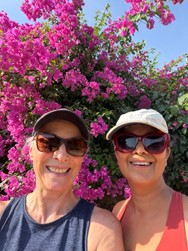
Rachael and I met years ago while working on the same team at a large technology company.
We were both pursuing our master’s degrees and discovered that we shared an interest in Appreciative Inquiry—a strengths-based approach to organizational change that asks us to look first at what is working well and build from there.
That shared interest eventually became something much bigger.
Together, we created a virtual Appreciative Inquiry Community of Practice within the company. It grew to around 300 members, gained executive sponsorship, and eventually led us to present our experiences at an international Appreciative Inquiry conference in Miami.
At the time, we were focused on the work.
We had no idea that one of the most lasting outcomes would be our friendship.
The project ended. Careers changed. Life moved forward.
But the friendship remained.
Totally Different Environments. Same Beautiful Friendship.
The last time I saw Rachael was in October 2023.
We met in Calgary and stayed near Canmore, with visits to Banff and Lake Louise. The first snowfall of the year had arrived the day before we did, and it was absolutely freezing.
It was also breathtaking.
When I met her at the airport, I wrapped my arms around her with tears in my eyes and said, “I’m SO GLAD you are alive.”
Rachael had been through a long and difficult period with her health, and recovery had taken far longer than anyone expected. It was years before she felt close to normal again.
So seeing her standing in front of me in Calgary — traveling, laughing, and fully present — mattered more than I can say.
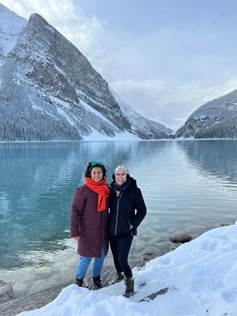
This September, nearly three years later, the environment couldn’t have been more different.
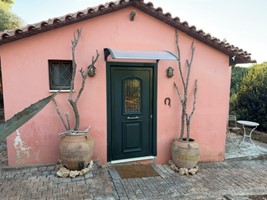
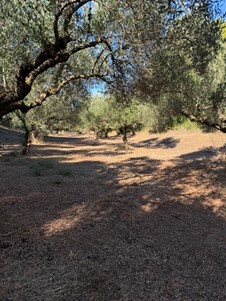
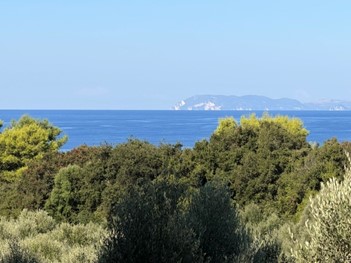
Instead of snow-covered mountains, we shared a small one-bedroom cottage on a hill in Greece, surrounded by olive trees, with the Ionian Sea on one side and the Mediterranean on the other.
I joked with her:
“Totally different environments. Same beautiful friendship.”
And somehow, by the end of the trip, that friendship felt even deeper.
Traveling to Experience a Place
One of the things I loved most about this trip was how little we rushed.
We weren’t racing from one tourist attraction to the next.
We had nowhere we had to be most days.
We sat on the patio. We talked. We hiked. We swam in crystal-clear water. We watched sunsets. We ate wonderful food. We explored when we felt like exploring and rested when we felt like resting.
It may have been one of the most relaxing trips I have ever taken.
And it reminded me how much I prefer traveling to experience a place rather than racing through a checklist.
There is something very different about staying long enough to notice ordinary life.
You begin to see more than landmarks.
You notice when people work.
You notice how they eat.
How families spend time together.
How long they linger over coffee.
What they grow.
What they make themselves.
What gets passed from one generation to another.
You begin to see the bonds that keep people connected to a place.
Rachael’s Greece
I had another advantage most tourists don’t have.
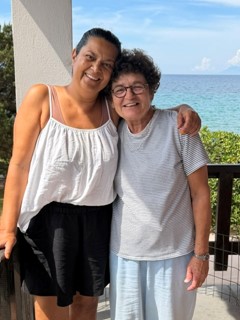
Rachael speaks Greek comfortably.
Thirty years ago, she taught English in Katakolo and rented an apartment from a Greek family. She stayed in touch with them, and over the decades they became what she calls her Greek family.
They consider her family too.
I had the privilege of meeting them.
The affection between them was palpable.
Here, in Greece, I saw belonging.
I saw decades of affection, loyalty, and connection.
It reminded me that family is not always defined only by biology.
Sometimes family is created through years of showing up for one another.
Because of those relationships, I didn’t simply see tourist Greece.
I saw Rachael’s Greece.
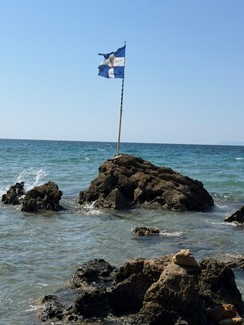
She took me to beaches only locals know about.
We ate at restaurants you would never stumble across without someone telling you exactly where to go.
One friend told us to visit a fish market in Pyrgos, buy whatever fish looked good, and ask them to cook it for us.
Even Rachael didn’t know they would do that.
So we bought our fish, handed it back to them, and ended up with a wonderful lunch.
It was spontaneous, local, and completely delightful.
Language Opens Doors
Traveling with someone who speaks the local language also showed me how much language changes an experience.
Most of the time, it simply allowed us to connect more deeply—to understand conversations, meet people, ask questions, and move through daily life with less distance between “us” and “them.”
And once, it got my money back.
I had purchased a bus ticket in Katakolo for a Friday trip to Olympia. The man who sold it to me spoke some English, and I was certain he understood the day I wanted to travel.
When I returned on Friday, his business was closed.
There was no bus.
Another local business owner later told us the man had done similar things before.
A few days later, Rachael came with me when I confronted him.
I explained in English that I wanted my money back.
He brushed me off and told me I had to wait for a woman who worked for him.
Then Rachael spoke to him in Greek.
“Why do we need to wait for the girl? You were the one who sold her the ticket.”
The look on his face changed immediately.
Suddenly, the problem became solvable.
He reached into his wallet and refunded my money.
Language didn’t just help me navigate Greece.
It helped me enter it.
Sometimes through friendship and conversation.
And sometimes through the very useful ability to say, in effect, “No. That’s not what happened.”
Living Close to the Land
What also struck me was how connected many of the families we met were to the land.
Olive trees were everywhere.
Families grew grapes and fruit.
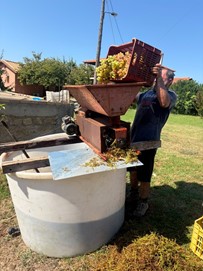
They made their own olive oil, olives, and wine.
Property often stayed within families.
And daily life seemed to move according to a rhythm that felt both practical and deeply social: work in the morning, a large midday meal, rest, coffee later in the afternoon, more work, and dinner much later in the evening.
Coffee, especially, wasn't something you grabbed on the way somewhere else.
It was something you sat down for.
For an hour.
Sometimes two.
It was social time.
Connection time.
Life was not separated from community quite as neatly as it often is at home.
Walking Through Thousands of Years
Of course, I also wanted to experience some of ancient Greece.
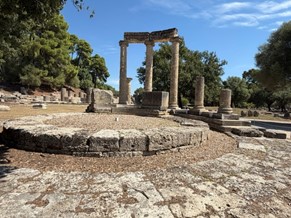
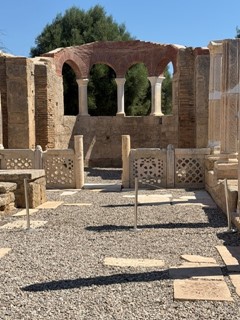
I drove to Olympia and walked through ruins that have stood in some form for thousands of years.
The site is enormous.
What struck me most was not simply that the ruins were old.
It was the scale of what had once existed there—the architecture, the public gathering places, the athletic traditions, the artistry, the engineering.
Standing there made history feel physical.
Not something in a textbook.
Something people had built, walked through, slept beside, worshipped in, competed in, repaired, and passed down.
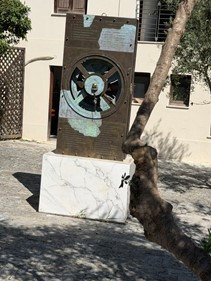
I also visited a small museum in Katakolo dedicated to ancient Greek technology and engineering.
The ingenuity fascinated me.
The museum displayed models and reconstructions of inventions involving water, timekeeping, astronomy, calculation, and mechanics.
Seeing them made me appreciate again how advanced ancient Greek engineering was—and how much knowledge human beings have created, lost, rediscovered, and reinvented across history.
The more I learned, the more I felt what international travel has always given me: perspective.
Travel as Education in Shared Humanity
I have long believed that international travel is one of the best forms of education we can give ourselves—and our children.
Not because it lets us say we have “been somewhere.”
But because, when we slow down enough, it lets us see how other people actually live.
Culture makes us fascinatingly different.
Ordinary life reminds us how much we are the same.
Families love one another.
People work hard.
They worry.
They celebrate.
They cook.
They argue.
They laugh.
They care for children.
They care for aging parents.
They want to belong.
They want dignity.
They want meaningful lives.
The longer I stayed, the less I felt like I was simply visiting Greece and the more I felt I was witnessing ordinary human life through a different cultural lens.
And I loved that.
The Ripples That Remain
September’s First Create Happiness theme was Purpose.
Before I left, I had already been thinking about an idea that kept resurfacing:
Sometimes purpose and meaning reveal themselves in the relationships and ripples that remain long after the original work is over.
This trip brought that idea home.
Rachael and I met because of work.
We built something meaningful together.
But the Community of Practice isn’t what I was thinking about while we swam in the sea, walked through olive groves, sat talking for hours on our patio, or laughed over another unexpected adventure.
I was thinking about how extraordinary it is that something which began in one chapter of life can become a gift in so many chapters that follow.
The work ended.
The friendship didn’t.
The ripples continued.
And perhaps that is true of far more of our lives than we realize.
A kindness.
An idea we shared.
A person we encouraged.
A relationship we nurtured.
Something we taught.
A door we opened.
We may never know how far those ripples travel.
What I Brought Home
I came home from Greece profoundly grateful.
Grateful for Rachael.
Grateful that she is healthy enough to hike and swim and laugh and travel.
Grateful for my own health and the freedom to still have adventures like this.
Grateful for the Greek family who welcomed me.
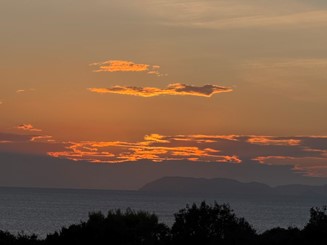
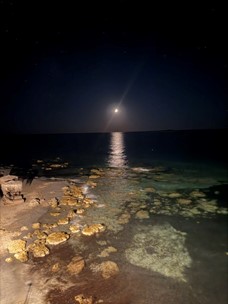
Grateful for hidden beaches, fresh fish, ancient stones, olive trees, long conversations, ridiculous bus tickets, moonlight on the sea, and sunsets I could have watched forever.
And grateful that we didn’t rush.
We stayed long enough to experience a place.
We stayed long enough to experience each other.
Maybe that is part of purpose too.
Not constantly asking, What should I accomplish next?
But occasionally stopping long enough to notice:
What has lasted?
Who is still beside me?
What am I grateful to be here for?
Some of life’s greatest gifts are not the things we set out to create.
They are the ripples that remain.
About the author
Cindi Bergen
As a child, Cindi believed in the magic of fairies — and as an adult, she never lost her ability to sense what’s unseen. Instead, she learned to translate it. What looks like magic to most isn’t an accident or a mystery… it’s the expression of universal principles most people never learned to read.
Through her own life experiences — from doubt to surrender, from stress to peace — Cindi became a bridge-builder between what the heart feels and what science proves. She intuitively translates deep spiritual insight into grounded understanding, and rigorous psychological research into actionable, heart-centered tools.
Her work is rooted in:
Cindi created the signature FLIP IT technique to help people shift out of negativity and into a positive perspective — not just temporarily, but in a way that becomes sustainable, embodied, and transformative.
She holds a master’s degree in Instructional and Performance Technology and has studied Appreciative Inquiry, a transformational change methodology grounded in psychology, sociology, and organizational behavior. Before dedicating her life to First Create Happiness, she spent years in training and development supporting Fortune 500 companies — helping people understand not just what to think, but how to think in ways that open possibility.
What she teaches isn’t about perfection. It’s about remembering who you truly are, reconnecting with your innate joy, and creating a life that reflects not just your desires — but your deepest self.
Cindi doesn’t ask you to believe blindly.
She invites you to experience what’s real.