
Learning to Trust What Others Already See
Self-trust has been my theme this month.
Not because I've mastered it.
Because I'm still learning it.
For a long time, I believed self-trust would feel like certainty. I imagined there would come a day when the doubts disappeared, the questions stopped, and I would finally feel completely confident in myself and my work.
That day never arrived.
What has arrived instead is something quieter.
Waiting to Feel Ready
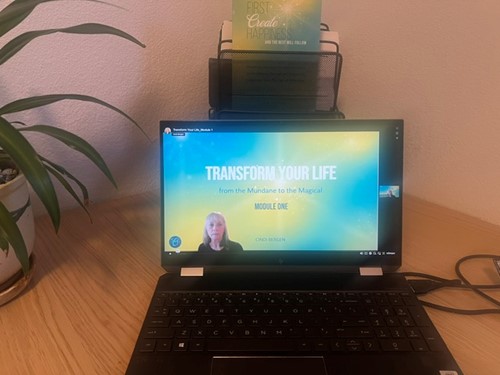
Over the past few months, I've been working on turning my live class, Transform Your Life from the Mundane to the Magical, into a self-paced online course. I've taught the material before. I know the content. I've seen the impact it has on people.
And yet, when it came time to record the modules, I found myself hesitating.
- Maybe I should revise one more slide.
- Maybe I should reorganize this section.
- Maybe I should wait until it feels more polished.
- More complete.
- More ready.
At some point, I realized I wasn't waiting for better content.
I was waiting for certainty.
The problem is that certainty rarely arrives before action.
So I took a deep breath and hit Record.
Not because I felt completely ready.
Because I trusted myself enough to begin.
The Evidence Arrives

Then something unexpected happened.
A former coaching client reached out after several years. We met for coffee and spent a wonderful morning catching up. Life had taken us in different directions, but the connection was still there. As we talked, it became clear that she was facing some challenges and could use support. We agreed to work together again in a coaching exchange.
A few days later, she sent me a text.
She introduced me to a friend she believed would benefit from coaching with me.
We have a discovery conversation scheduled later this month.
At first, I was simply grateful.
Then I noticed something deeper.
This woman had experienced my coaching firsthand. She knew my style. She knew my approach. She knew what it felt like to work with me.
And she trusted me enough to recommend me to someone she cared about.
That's when a thought landed.
Maybe other people have been seeing this version of me for a while.
Maybe I'm the one who's still catching up.
Trusting the Evidence
I think many of us do this.
- We discount our strengths.
- We minimize our growth.
- We focus on what we haven't done yet rather than what we've already accomplished.
- We keep asking for more proof while quietly ignoring the evidence that's already there.
Self-trust doesn't always arrive as a feeling.
Sometimes it arrives as evidence.
- The class you've taught.
- The challenge you've survived.
- The promise you've kept.
- The relationship you've nurtured.
- The person who believes in you.
- The life you've already lived.
Perhaps self-trust isn't about convincing yourself that you're capable.
Perhaps it's about becoming willing to believe the evidence.
This month I've been teaching that self-trust grows one piece of evidence at a time.
The truth is, I'm learning that lesson too.
Recording the course wasn't evidence that I was ready. It was evidence that I was willing.
The coaching referral wasn't evidence that I suddenly became qualified. It was evidence that I already was.
I used to think self-trust would feel like certainty.
Now I think it feels more like a quiet willingness to take the next step.
To trust what you've learned.
To trust what you've lived.
And sometimes, to trust what others already see.
Thanks to Magnific for the image.
About the author
Cindi Bergen
As a child, Cindi believed in the magic of fairies — and as an adult, she never lost her ability to sense what’s unseen. Instead, she learned to translate it. What looks like magic to most isn’t an accident or a mystery… it’s the expression of universal principles most people never learned to read.
Through her own life experiences — from doubt to surrender, from stress to peace — Cindi became a bridge-builder between what the heart feels and what science proves. She intuitively translates deep spiritual insight into grounded understanding, and rigorous psychological research into actionable, heart-centered tools.
Her work is rooted in:
Cindi created the signature FLIP IT technique to help people shift out of negativity and into a positive perspective — not just temporarily, but in a way that becomes sustainable, embodied, and transformative.
She holds a master’s degree in Instructional and Performance Technology and has studied Appreciative Inquiry, a transformational change methodology grounded in psychology, sociology, and organizational behavior. Before dedicating her life to First Create Happiness, she spent years in training and development supporting Fortune 500 companies — helping people understand not just what to think, but how to think in ways that open possibility.
What she teaches isn’t about perfection. It’s about remembering who you truly are, reconnecting with your innate joy, and creating a life that reflects not just your desires — but your deepest self.
Cindi doesn’t ask you to believe blindly.
She invites you to experience what’s real.