
FLIP IT™ and the Gold in the Cracks
How a simple thought-shifting tool became a process for healing old stories
When I first created FLIP IT™, I thought I was creating a practical tool for changing negative thoughts. That was the original idea.
Feel what is happening.
Listen to the thought underneath it.
Intervene with facts and a better-feeling perspective.
Promote the positive.
It was simple.
Memorable.
Useful.
And I still believe it works beautifully as a thought-shifting process.
But after using FLIP IT™ with people in classes, coaching conversations, and real-life moments of emotional struggle, I began to realize something important.
The thought is rarely the whole story.
The thought is often the doorway. Underneath it, there may be an old belief.
- A wound.
- A role.
- A fear.
A story about who we are, what we deserve, or how safe it is to be fully ourselves.
And that is where FLIP IT™ became much deeper than I first understood.
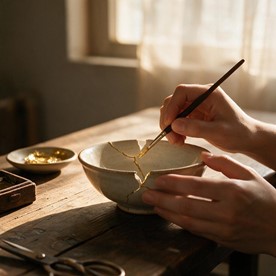
The crack is not the flaw
There is a Japanese art form called Kintsugi, where broken pottery is repaired with gold.
The crack is not hidden.
It is not treated as something shameful.
It becomes part of the piece’s history.
Part of its beauty.
Part of what makes it unique.
I have come to see FLIP IT™ in a similar way.
So often, people come to the process believing something is wrong with them.
- They are too emotional.
- Too sensitive.
- Too negative.
- Too angry.
- Too anxious.
- Too stuck.
But when we slow down and listen beneath the surface thought, we often discover something very different.
The reaction makes sense.
The feeling has a history.
The belief came from somewhere.
The pattern may have once protected them.
What looked like a flaw may actually be a place where life left a mark. And healing does not come from pretending the crack was never there. It comes from bringing awareness to it.
The coat we thought we had to burn
Clarissa Pinkola Estés shares a story in Women Who Run with the Wolves about a healing exercise involving an old coat.
The idea was to sew patches onto the coat, each one representing a time of being harmed, discounted, wounded, or undervalued. The coat would become a visible record of the pain. And when the work was complete, it would be burned as a ritual of release.
But when she did the exercise herself, something unexpected happened.
After spending so much time with the coat — naming the wounds, stitching the patches, witnessing the story — she could no longer see it only as something painful.
It had become a badge of courage. So she kept it.
I think about that often.
Sometimes healing does not mean erasing the story.
Sometimes healing means changing our relationship to it.
The wound is no longer hidden.
The pain is no longer carrying the same shame.
The story is no longer proof that we are broken.
It becomes part of what shaped our courage, compassion, and strength.
Not because the pain itself was good.
But because what we did with the pain became meaningful.
That is where FLIP IT™ often leads us.
Not to denial.
Not to forced positivity.
But to a new relationship with the places we once thought made us flawed.
A moment I will never forget
One of the clearest examples happened in one of my online classes.
I worked with a woman who had immigrated to the United States from what had been Czechoslovakia, now the Czech Republic.
She was struggling with feeling dismissed and undervalued because her professional credentials did not transfer easily to the U.S.
On the surface, the issue seemed obvious.
- She had worked hard.
- She had experience.
- She had knowledge.
And now she was in a new country where that experience was not being fully recognized.
So we began with the feeling.
I do not feel valued.
That feeling was real. Her frustration was valid.
But as we moved through the FLIP IT™ process, something deeper began to emerge.
The “not valued” feeling did not begin in the United States.
It reached back much further.
To childhood.
To growing up in a system where individuality was not encouraged.
To a place where being seen as a unique person with her own gifts, voice, and value had not been nurtured in the way she needed.
When she saw that, there was visible relief. I will never forget it.
The situation in the present still mattered. The credential issue was still real.
But suddenly, she could see that the intensity of the feeling was connected to an older story.
She was not flawed.
She was carrying an old narrative.
That is the power of FLIP IT™. It helps us separate who we are from the story we have been carrying. And to me, that is Kintsugi.
- Not hiding the crack.
- Not pretending the wound did not matter.
- But bringing gold to the place where we once saw only damage.
This is where FLIP IT™ becomes more than a mindset tool.
It gives us a way to move from reaction to recognition, from old story to new choice.
The process is simple:
Feel. Listen. Intervene. Promote the Positive.

Feel: where the gold begins
The first step of FLIP IT™ is Feel.
This may sound simple, but for many people it is the hardest part.
We live in a culture that often teaches us to override our feelings.
- Stay busy.
- Be strong.
- Get over it.
- Think positive.
- Move on.
But feelings do not disappear just because we ignore them.
They often speak through the body first.
- A tight chest.
- A clenched jaw.
- A knot in the stomach.
- A sudden wave of anger.
- A heaviness we cannot explain.
The Feel step invites us to pause long enough to notice what is happening inside.
Not to judge it.
Not to fix it immediately.
Just to notice.
Because the feeling is often the doorway into the deeper story.
Listen: finding the story beneath the thought
The second step is Listen.
This is where the process becomes more than positive thinking.
We listen for the thought. But we also listen beneath the thought.
- What am I believing right now?
- What does this situation seem to mean about me?
- Why does this feel so painful?
- Where have I felt this before?
- What old story might be getting activated?
This is where people often have their “aha” moment.
The moment they realize the present situation is real, but the emotional charge may be connected to something older. The moment they see that they are not overreacting. They are reacting from a story that has been waiting to be seen.
That is where compassion enters.
And compassion is gold.
Intervene: bringing truth to the crack
The third step is Intervene.
This is not about arguing with yourself.
It is not about forcing a happy thought over a painful one.
It is about bringing truth into the place where an old belief has been running the show.
Sometimes the intervention begins with facts.
- What do I actually know?
- What am I assuming?
- What evidence am I ignoring?
- What else could be true?
Sometimes it goes deeper.
- Is this belief mine?
- When did I learn this?
- Did this belief once help me survive, belong, or stay safe?
- Does it still fit the person I am now?
This is where we begin to repair the crack.
Not by denying it.
By seeing it clearly.
A thought like “I am not valued” may become:
I am feeling undervalued right now, and this feeling has a history. But my value is not determined by whether this system recognizes my credentials.
That is not pretending.
That is truth.
That is gold.
Promote: strengthening the new story
The final step is Promote the Positive.
This is where we choose what to strengthen.
Not fake positivity.
Not denial.
Not spiritual bypassing.
A truer thought.
A supportive action.
A compassionate practice.
A new way of relating to ourselves.
If the old story was: I am not valued.
The new practice may become: I can honor my value even when others do not recognize it immediately.
If the old story was: I have to be strong for everyone.
The new practice may become: I can ask for help and still be strong.
If the old story was: My feelings are too much.
The new practice may become: My feelings are information, not a flaw.
This is how we begin to create new pathways.
Little by little.
Choice by choice.
Practice by practice.
The repair becomes part of the beauty
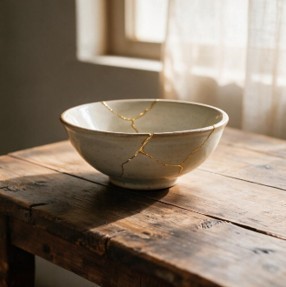
Kintsugi does not return the bowl to what it was before it broke.
It creates something different.
- Something honest.
- Something with history.
- Something that carries both the break and the repair.
I think healing is often like that. We do not become untouched. We do not erase everything that shaped us. But we can stop confusing our wounds with our identity.
We can stop believing every old story that rises up inside us. We can stop treating our cracks as proof that something is wrong with us.
And we can begin filling those places with awareness, compassion, truth, and choice.
That is what FLIP IT™ has become for me. Not just a tool for changing thoughts.
- A process for discovering what is driving the thought.
- A way to listen beneath the reaction.
- A practice for separating who we are from what we learned to believe.
A kind of inner Kintsugi.
The crack may be part of the story.
But it is not the whole story.
And sometimes, with enough awareness and compassion, the place we once saw as broken becomes the very place where the light gets in.
About the author
Cindi Bergen
As a child, Cindi believed in the magic of fairies — and as an adult, she never lost her ability to sense what’s unseen. Instead, she learned to translate it. What looks like magic to most isn’t an accident or a mystery… it’s the expression of universal principles most people never learned to read.
Through her own life experiences — from doubt to surrender, from stress to peace — Cindi became a bridge-builder between what the heart feels and what science proves. She intuitively translates deep spiritual insight into grounded understanding, and rigorous psychological research into actionable, heart-centered tools.
Her work is rooted in:
Cindi created the signature FLIP IT technique to help people shift out of negativity and into a positive perspective — not just temporarily, but in a way that becomes sustainable, embodied, and transformative.
She holds a master’s degree in Instructional and Performance Technology and has studied Appreciative Inquiry, a transformational change methodology grounded in psychology, sociology, and organizational behavior. Before dedicating her life to First Create Happiness, she spent years in training and development supporting Fortune 500 companies — helping people understand not just what to think, but how to think in ways that open possibility.
What she teaches isn’t about perfection. It’s about remembering who you truly are, reconnecting with your innate joy, and creating a life that reflects not just your desires — but your deepest self.
Cindi doesn’t ask you to believe blindly.
She invites you to experience what’s real.